
ECOWEEK 2027 SOFIA, BULGARIA
Cultural Heritage Religious, Industrial and other sites
Preservation, Community and Sustainability
October 17 - 23, 2027
International conference and workshops on cultural heritage as a shared urban space, a shared experience: preservation and reuse, sustainability – social, environmental, cultural, economic and technological - inspiration and innovation

about
ECOWEEK : 22-years of international design sustainability and urban innovation.
Sustainable design in more than 30 cities in 19 countries around the world in more than 200 workshops on sustainable design,
with hundreds of placemaking and urban hands-on design-build interventions and design proposals that engaged more than 4500 students and young professionals in architecture and design and through public participation, engaged thousands of local stakeholders! Hundreds of expert speakers and leading keynote speakers to share, teach and inspire!
Explore the ECOWEEK resources:

overview
ECOWEEK 2027 is the first ECOWEEK event in Sofia, Bulgaria. The principle organizers are:
ECOWEEK - ECOAMA, Greece (link) with head organizer architect Dr. Elias Messinas, the creator of ECOWEEK in 2005 with the vision to promote sustainability through design, with activity in 19 countries around the world.
BALKAN STUDIES INSTITUTE, Sofia, Bulgaria (link) with head organizer Ivaylo Nachev, at the Bulgarian Academy of Sciences, founded on January 15, 1964 by a decision of the Council of Ministers of the People's Republic of Bulgaria under the auspices of UNESCO, as a research and educational center for languages, history, culture and modern development of the Balkans.
ECOWEEK 2027 partners include the “Ion Mincu” University of Architecture and Urbanism, Bucharest, Romania, the Department of Architecture, Democritus University of Thrace, Xanthi, Greece, the School of Architecture, Frederick University, Nicosia, Cyprus, NetHood (Switzerland), and European Horizon Project SINCERE. More partners are expected to join.
ECOWEEK 2027 is a multidisciplinary event that invites the participation of post-doctorate, doctorate, graduate and undergraduate students, professionals, young professionals, researchers, practicioners and theoreticians, in Cultural Heritage, Architecture, Engineering, Interior Design, Landscape Design, History, Ethnology, and more.


ECOWEEK 2027 in Sofia aims to address contemporary issues and challenges of cultural heritage from a variety of perspectives: from a shared urban space, to a shared experience, and addressing issues of cultural heritage preservation and reuse, and the sustainability parameters to achieve this – social, environmental, cultural, economic, technological and from the perspective of inspiration and innovation.
ECOWEEK 2027 will draw from a wealth of expertise of researchers, professionals and practitioners from several countries, aiming to share notes, generate dialogue, inspire for new and scale up of existing initiatives, initiate cooperation and networking for joined projects, aiming to benefit the cultural heritage in participating countries in particular and in Europe in general.

ECOWEEK 2027 is a combination of expertise: on one hand, the interactive ECOWEEK conference and workshops format, and on the other the experience and methodology of BALKAN STUDIES INSTITUTE in scientific conferences, to ensure a high quality event for academics, researchers, professionals and students.
The pre-event process will include call for sessions and call for papers, for speaker sessions, roundtables, panels, training sessions and workshops. The workshops will be interactive and some may be hands-on. Technical training sessions on-site experimentation will explore advanced technologies. Activity will include site visit(s), free-hand architectural sketching, and final presentation of the workshop projects with crits and discussion. The outputs of the conference may include an exhibition, and aiming for a catalogue and proceedings.
ECOWEEK 2027 will focus on religious, industrial and other cultural heritage buildings. Will address issues of preservation, design, reuse and rehabilitation, challenges of environmental upgrade, rescue operations, will look at advanced materials and technologies, and to a certain extent, address also immaterial aspects of cultural heritage.
Credits for photos on this page: ECOWEEK. Credits for sketches on this page: Elias Messinas

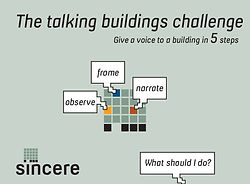
The TalkingBuildings tool was developed by NETHOOD for the SINCERE Horizon program. It will enhance the conference and workshop experience and redefine the relationship of historic buildings to their modern urban contexts. The TalkingBuildings session will be incorporated in the workshop brief and tried out by the workshop group and also lead a professional training session to identify and document Cultural Heritage buildings through technology and the senses.
The main assumption behind the SINCERE's TalkingBuildings tool is that the process of giving a voice to buildings can reveal important aspects of their condition and potential future. It produces also very playful and inspiring outcomes that can attract attention and stimulate creative engagement. The tool has been successfully applied in Rhodes, Xanthi, Graz, Vienna and elsewhere. The platform talkingbuildings.net collects the voices of all these buildings created by professionals and students, and offers a basic understanding of the concept.

program
17.10 Sofia Arrival & Informal group activity in the afternoon [1]
18.10 Sofia 10:00 Opening session, orientation, workshops introduction. Site visit(s).
19:00 Keynote Lecture: Architect Bruce Becker (Becker + Becker, USA) [2]
19.10 Sofia 10:00 Professional training sesson. Lecture Sessions and Workshops.
19:00 Keynote Lecture: Architect Veronica Răileanu ('Ambulance for Monuments', Romania) [2]
20.10 Sofia 10:00 Lecture Sessions and Workshops. Group activity [3]
19:00 Book Presentations [2]
21.10 Sofia 10:00 Lecture Sessions and Workshops. Group activity [3]
19:00 Group activity [2]
22.10 Sofia 10:00 Workshop Presentations. Group activity [2]
Keynote Lecture: Architect Xander Vermeulen Windsant (XVW, Netherlands) [2]
23.10 Sofia Free time and Departure
Venues:
[2] Venue 2 [TBA]
[3] Venue 3 [TBA]

workshops
 |
|---|
 |
 |
|---|
|
 |
|---|
|
 |
|---|
|
 |
|---|
 |
|---|
 |
|---|
W1. [TBA] Interventions in a cultural heritage building
Objective: TBA
Workshop Coordinator: TBA
W2. [TBA] Documenting a cultural heritage building through technology and senses
Objective: TBA
Workshop Coordinator: TBA
W3. [TBA] Cultural heritage and technology
Objective: TBA
Workshop Coordinator: TBA
W4. [TBA] Reuse of a cultural heritage building
Objective: TBA
Workshop Coordinator: TBA
** Workshop themes are tenative and likely to change. More details and description will be posted shortly.
W [all]. TalkingBuildings
When Cultural Heritage buildings tell their own story: an architectural and design project, with interior design, architectural, preservation and rehabilitation focus, that uses technology and storytelling to build contemporary narratives for cultural heritage buildings.
Workshop Intergration Coordinator: Panayotis Antoniadis, Nethood Zurich and Dr. Elias Messinas, ECOAMA-ECOWEEK. Suitable to all participants.
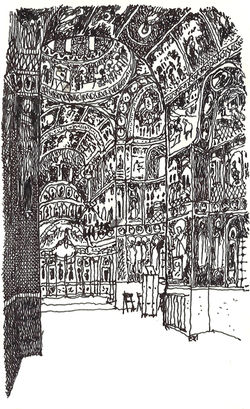
Free-hand Architectural Sketching
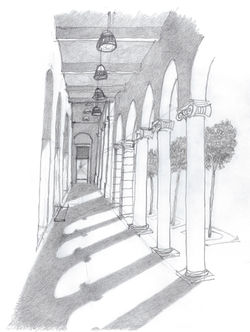
We discuss and design for Cultural Heritage but we also understand and appreciate it through observation and free-hand sketching. When machines learn how to think for - and instead of - us, we develop our abilities to see and think through free-hand sketching and understanding the historic urban context, the perspective drawing and the details and relationships of historic buildings. Sofia is an amazing city to sketch buildings, landscapes, religious and other monuments, and a very rich texture of architecture and design. Interior and exterior.
Session Coordinator: Dr. Elias Messinas, ECOAMA-ECOWEEK. Suitable to all participants.
Credits for sketches on this page: Elias Messinas
 |
|---|
 |
 |
 |
 |
 |
Workshops Coordinators & Speakers:
Ileana Apostol (PhD Planning, University of Southern California, Los Angeles) is a researcher of spatial production in the information age, co-founder of Zurich-based NetHood association, and co-initiator of the L200 space, a community-run "living lab" in Zurich. Has taught urban sociology at ETH Zurich, urban planning and design in Los Angeles at California Polytechnic University, and University of Southern California, and architecture and urbanism at the University of Architecture and Urbanism in Bucharest. [NETHOOD]
Panayotis Antoniadis is co-founder of NetHood, a Zurich-based non-profit association that combines research and action around a wide variety of participatory processes at the neighbourhood level. He has a highly interdisciplinary profile with senior researcher positions at ETH Zurich, research visits in top universities
like University of Southern California, Princeton, London School of Economics, and Cambridge, and key roles in the Internet Society Switzerland Chapter, and the L200 space in Zurich. In the Horizon Europe project SINCERE, he co-developed the TalkingBuildings methodology for community engagement around issues of preservation and sustainable renovation of cultural heritage buildings. [TalkingBuildings]
Elias Messinas is an architect, urban planner and the creator of ECOWEEK. Graduate of Yale School of Architecture, he holds a PhD on Urban Planning and an MSc on Environment and Development from the National Technical University of Greece. A former postdoctoral fellow at the Faculty of Architecture at the Technion Institute of Technology, we conducted research on passive solar architecture at the Desert Architecture Unit of Ben Gurion University. A former scientific advisor to the Ministry of Culture of Greece on the enrichment of the National Archaeological Registry, he collaborated with the Eforate of Antiquities of Pireas and Islands in the protection of the ancient synagogue of Aegina, Greece. He teaches architecture and design and engages in research on documentation and digital reconstruction of cultural heritage buildings. He practices and teaches sustainable design and public participation in urban planning. Partner in the Horizon Europe project SINCERE on energy conservation of cultural heritage buildings, managing a Brutalist case study. Project architect and coordinator of private and public cultural heritage renovation and reuse projects in Greece and abroad. Author of 15 books and numerous articles, he has lecturered widely.[ECOAMA] [ECOWEEK] [EliasBlue]
 |
|---|
Conference Scientific Committee:
-
Dr. Ivaylo Nachev, Balkan Studies Institute, Sofia
-
Dr. Elias Messinas, Holon Institute of Technology, Holon
-
Prof. Ruben Paul Borg, University of Malta, Faculty of the Built Environment, Msida
-
Prof. Maria Grigoriadou, Democritus University of Thrace, Xanthi
-
Prof. Mihaela Harmanescu, “Ion Mincu” University of Architecture and Urbanism, Bucharest
-
Prof. Natasa Kapandriti, Democritus University of Thrace, Xanthi
-
Prof. Lorin Niculae, “Ion Mincu” University of Architecture and Urbanism, Bucharest
-
Prof. Marios Pelekanos, Frederick University, Nicosia
-
Prof. Dimitris Polychronopoulos, Democritus University of Thrace, Xanthi
-
Dr. Konstantinos Sampanis, Vienna University, Dept. of Byzantine & Modern Greek Studies, Vienna

keynotes
 |
|---|
 |
 |
 |
 |
 |
 |
 |
 |
 |
 |
 |
Bruce Redman Becker is President of Becker + Becker, an integrated sustainable architecture and development firm in Westport, Connecticut, a Fellow of the American Institute of Architect, a LEED Accredited Professional, and a Certified Passive House Designer. Bruce received a B.A. from Amherst College in American Studies and Fine Arts, and MBA and Master of Architecture degrees from Yale University.
Bruce designs buildings that have a transformative social and environmental value. His work includes historic rehabilitation and adaptive reuse of historic building Wauregan Hotel in Norwich, CT into 70 units of affordable housing and retail shops. The firm also restored the historic Octagon tower on Roosevelt Island in Manhattan to create a 500-unit mixed-income community and waterfront park. Most recently, Bruce completed the certified historic rehabilitation of the Pirelli building in New Haven, originally designed by Marcel Breuer, into Hotel Marcel - a 165-room boutique hotel that uses no fossil fuels and is the first Passive House certified hotel in the United States. Bruce also designed the headquarters for the Cary Institute of Ecosystem Studies in Millbrook, NY, and served as master planner for Amherst College.
He is a frequent lecturer and design critic at Yale University and speaker at architecture, historic preservation and sustainable development industry events.
Bruce was appointed by President Biden in May 2024 to serve as one of the seven Commissioners of the United States Commission of Fine Arts, and fired by President Trump in October 2025 together with all other Commission appointees.
Xander Vermeulen Windsant the principal architect and founder of XVW Architecture in the Netherlands.
Xander studied at Delft University and after working with one of the leading architecture offices in Amsterdam, he established XVW Architectuur in 2010 in order to independently address a new agenda for architecture as a resilient response to a rapidly changing world. Xander sees the collaboration with future occupants as a key aspect of the design process. Xander won the Mies van der Rohe Award’s EU Prize for Contemporary Architecture in 2017 for his socially engaging approach. Xander is a visiting lecturer at a number of institutions including the Delft, Aarhus School of Architecture, and the Politcehnico Milano. He is a contributor to the Dutch Online Architecture platform Archined.nl. and was Chairman of the Architecture Center in ‘s-Hertogenbosch.
Veronica Răileanu is a Romanian architect whose work focuses on cultural heritage, vernacular architecture, and rural communities. After graduating from Architecture School, she left Bucharest and moved to a village in the heart of Transylvania, where she coordinates the program "Ambulance for Monuments" (Ambulanța pentru monumente). An award-winning Romanian heritage initiative launched by the Monumentum Association in 2016, the Ambulance for Monuments is a Romanian initiative to safeguard endangered built heritage through emergency interventions. Its network of ten independent organisations brings together heritage professionals, craftspeople, volunteers, local communities and public authorities. Over ten years of activity, it has carried out more than 120 interventions and involved over 3,000 volunteers. The program combines urgent repairs with practical training, the preservation of traditional building skills and shared responsibility for heritage.

registration
Registration to ECOWEEK 2027 has five categories in Early Registration and Regular Registration:
EARLY Registration until June 30, 2027**
Participant 200 Euro for one day or more
Paper Presenter | Speaker | Poster Presenter 150 Euro
Chair Organizer | Moderator 75 Euro
Workshop Leader Free participation - requires presence for most of the week
Student 60 Euro for individual and 50 Euro per participant for groups of 5+ students - requires presence for the full week
** Participants from Bulgaria are entitled to a 25% discount in registration.
REGULAR Registration starting July 1, 2027**
Participant: 250 Euro for one day or more
Paper Presenter | Speaker | Poster Presenter 200 Euro
Chair Organizer |Moderator 85 Euro
Workshop Leader Free participation - requires presence for most of the week
Student 100 Euro for individual and 80 Euro per participant for groups of 5+ students - requires presence for the full week
** Participants from Bulgaria are entitled to a 25% discount in registration.
Registration fee reserves your participation in the lecture sessions and/or workshops only. Registration does not include flight, transportation, local transportation, insurance (obligatory), accommodation, meals and all other accrued expenses, undertaken by each participant individually.
For workshop participants: You are obliged to bring your own laptop and personal work tools at your responsibility. Travel insurance for foreign and local students is obligatory. Please read and accept the terms and conditions for participation to ECOWEEK 2027 in the registration form.
Registration discounts and some scholarships may be available.
REGISTRATION STARTS HERE: LINK
1. Registration Form >> in case of over-booking, the waiting list is based on first-come-first-serve basis upon cancelations.
2. Confirmation Email >> will be sent with payment instructions.
3. Final Confirmation Email >> will follow to confirm your participation.
Please note:
Participation in the ECOWEEK 2027 workshops requires a time commitment. You agree with your registration that you allocate this time in order to be present and active in your workshop group. Specific instructions and guidelines for each group will be handed by the workshop coordinators.
Cancellation Policy
For Participants, Students, Chair Organizers and Speakers Registration:
Early Registration is non-refundable.
Regular Registration cancellations/refunds will only be processed for requests received in writing at ecoweek@ecoweek.org by September 15, 2027. No refunds will be available for cancellations received starting September 16, 2027.
submit
UPLOAD YOUR ABSTRACT HERE
DOWNLOAD CALL FOR SESSIONS HERE >> The call is open
GUIDELINES
Chair Session submissions deadline: 15 December 2026 >> The call is open
Sessions abstracts approved by: 30 December 2026
Call for papers and posters opens: 1 January 2027
Deadline for call for papers: 15 February 2027
All abstracts are submitted via the CMT platform: link
SESSION FORMATS
-
Panel Discussions: Moderator and 4-6 speakers followed by Q&A session. Duration 90 minutes. Each presentation up to 15 minutes.
-
Roundtables: Moderator and group of 4-6 speakers. Moderated discussion develops after the presentations. Duration 90 minutes. Each presentation up to 15 minutes.
-
Research Sessions: Chair and 4-6 speakers sharing academic research, followed by individual questions. Duration 90 minutes. Each presentation up to 15 minutes.
-
Training Sessions: Professional and 8-15 participants in a hands-on educational session designed to teach professionals and students the use of advanced tools or methods of recording or analyzing cultural heritage, by applying them in a specific assignment. Duration 90 minutes. May take place outdoors.
-
Workshops: Workshop 1-2 moderators and teams of 6-10 students of Architecture, Design, Conservation, on a cultural heritage theme, focusing on an actual building in Sofia. Necessary to provide solid background (digitized architectural plans) and understanding of the site, preferably, in a context that may generate contrasts, conflicts and creative discussion and thinking for the preservation and reuse of the chosen site.
SUBMISSION FORMAT
Session Required Information:
- Name, affiliation, department, and contact details of the moderator/chair/organizers (one or two people per session).
- Session title.
- Brief summary of the proposed session.
- Indicative bibliography.
- Up to 2 pages, Times Roman 11, 2.54 margins, 1.15 line spacing.
Workshop Required Information:
- Name, affiliation, department, and contact details of the moderator/workshop leaders (one or two people per session).
- Workshop title.
- Brief summary of the proposed workshop.
- Suggested site in Sofia (indicative).
- Indicative bibliography.
- Up to 2 pages, Times Roman 11, 2.54 margins, 1.15 line spacing.
- Workshop brief:
Workshop leader proposes a workshop theme around cultural heritage buildings, that explore the intersections of architecture, design, preservation, adaptation, reuse and sustainable upgrade of historic cultural heritage buildings – or complexes - in Sofia (preferably walking distance from workshop venue). Aiming to create a vibrant platform for students of Architecture, Design and Conservation to engage in hands-on interdisciplinary experience, that inspires creativity, critical thinking and innovative approaches to cultural heritage preservation and reuse.
Workshops cater for graduate and undergraduate students of Architecture, Design and Conservation at least in their second year. Workshops take place every day during the ECOWEEK event between 10:00 and 17:00 and are located in institution facilities. Site visits are encouraged. Presentations take place on the last day of the ECOWEEK event. All workshops will be conducted in English.
Submission Evaluation:
The following points will be taken into consideration when evaluating the session / workshops proposals:
- The quality of the proposed event.
- The novelty and relevance of the topic.
- Suitability of the chair/moderator to the proposed event.
- The feasibility of hosting it, such as special equipment, materials or tools.

Copyright ECOWEEK 2021
partners
 |
|---|
 |
|---|
 |
|---|
 |
|---|
 |
|---|
 |
|---|
 |
|---|
 |
|---|
 |
|---|
 |
|---|
 |
|---|
 |
|---|
 |
|---|
 |
|---|
 |
|---|
 |
|---|
 |
|---|
The Microsoft CMT service was used for managing the peer-reviewing process for this conference. This service was provided for free by Microsoft and they bore all expenses, including costs for Azure cloud services as well as for software development and support.


